Pain In Chest On Left Side When Breathing . Pleurisy is a condition that causes sharp, stabbing pain under your breast that can be made worse by breathing in deeply. Pneumonia is an inflammation of the air sacs in the lungs. Pin on Curiosities from www.pinterest.com The pain may worsen when the person breathes in. Pneumonia is an inflammation of the air sacs in the lungs. 9 to ease the chest pain you can use a hot compress on the affected area a few times a day to relieve the pain.
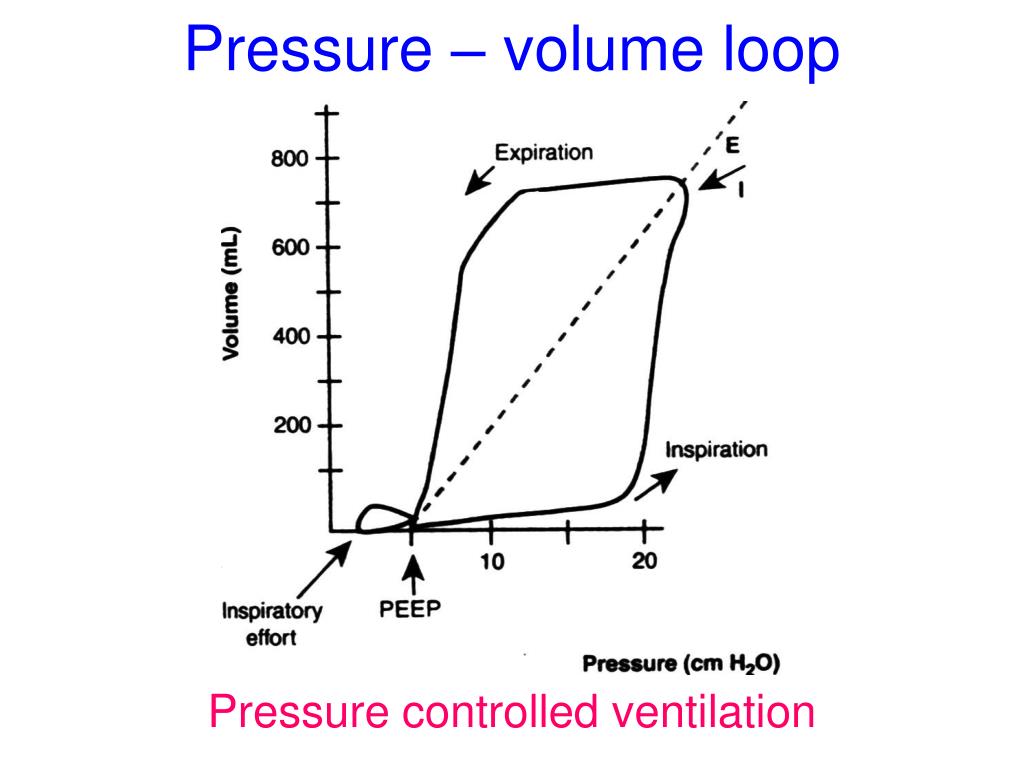
Pressure Volume Loop Ventilator. The gradual change in pressure, flow and volume depend to an equal extent on the properties and settings of the ventilator, as well as on the respiratory properties of the lung. Inspiration is in green, exhalation is in yellow.
PPT Interpretation of Ventilator Graphics PowerPoint from www.slideserve.com
Work = (pressure x area) x (volume/area) Thorough understanding of both scalars and loops, and their characteristic appearances, is essential to being able to evaluate a patient’s respiratory mechanics and interaction with the ventilator. The gradual change in pressure, flow and volume depend to an equal extent on the properties and settings of the ventilator, as well as on the respiratory properties of the lung.
Force = Pressure X Area.
It will be at 0 if there’s no peep set. Graphical representation of relationship between pressure and volume during inspiration and expiration. The inspiratory curve goes upward, and the expiratory curve goes downward.
This Causes A “Noisy” Signal On Both Scalars And Loops And Is The Result Of Turbulence Created By Flow In The Water Or Secretion Either In Et Tube Or Circuit.
In this situation, the flow is delivered at a constant rate, which causes pressure to increase in a predictable pattern. • the v t target is a “minimum” value, so patients can breath above this value. • each subsequent mandatory vg breath will adjust pressure (~3cmh 2 o) to deliver the preset v t target.
35 The Static Relationships Can Be Used To Analyze The Properties Of The Respiratory System And Help Guide Mechanical Ventilation.
Thorough understanding of both scalars and loops, and their characteristic appearances, is essential to being able to evaluate a patient’s respiratory mechanics and interaction with the ventilator. Cardiovascular physiologist adam goodwill (p.h.d) provides an introduction to the pv loop, how it compares to other techniques (echocardiography and cardiac mri), plus tips for interpreting measures of cardiac function. Used to estimate work of breathing in terms of expiratory and inspiratory components.
The Gradual Change In Pressure, Flow And Volume Depend To An Equal Extent On The Properties And Settings Of The Ventilator, As Well As On The Respiratory Properties Of The Lung.
This is the pressure/volume loop. Application of modified derived equations of motion of respiratory. The settings on the ventilator are vt 450 ml, square flow waveform, and 5 cmh 2 o peep.
Identifying It May Help In Doing Secretion Before They Organize And Block The Airway.
Work = (pressure x area) x (volume/area) To eliminate resistive and convective acceleration effects, the measurement of volume and pressure must be performed during short periods of apnea or during very slow flow. That pressure, flow and volume can be displayed simultaneously makes it easier to detect changes caused by the system or the lungs.


Comments
Post a Comment